To our knowledge, use of wool pellets as a soil amendment in the U.S. was pioneered by Albert Wilde (Wild Valley Farms), a 6th generation sheep rancher. The Wildes run 2,600 head of sheep (and 200 head of cattle) in Croydon, Utah. At some point Albert Wilde came up with the notion of pelletizing wool from his sheep, and using them as a soil supplement. He embarked on a series of studies around 2016 exploring the influence of wool pellets on the yield of vegetables, primarily tomatoes. Prior to his work, many people recognized the value of wool as a mulch in gardening to retain water while inhibiting the growth of weeds. Wool pellets pose advantages over raw wool as a mulch in that they can improve the texture as well as the water-retentive properties of soils, being much easier than raw wool to incorporate into soil. By swelling as they absorb water, they can create air pockets that foster the growth of roots. They also provide a “slow release” supply of water and nutrients (chiefly nitrogen; most analyses of wool pellets run 9-0-2, N:P:K, which is higher in N than most other natural fertilizers, such as poultry manure).
The Wool Channel (a blog dedicated to alternative uses for wool) picked up on this story in 2021. That same year an article describing early results obtained with wool pellets (from Albert Wilde’s studies) appeared in American Wool. Interest began to grow among individual sheep producers seeking to reduce waste from their flock (skirtings, fleeces with a weakness) or – in the case of fleeces with relatively little commercial value – from producers seeking to recoup the cost of shearing. The equipment required to shred and to pelletize wool seemed a natural complement to small fiber mills, many of which are presented with wool requiring skirting, producing substantial waste. (Small fiber mills also possess the skills required to maintain heavy machinery).
A few years after the Wool Channel’s article appeared, we began to follow the research findings surrounding wool pellets. One of the earliest U.S. external studies we were able to locate was carried out by University of Vermont Extension. Conducted in 2019, researchers explored the influence of wool pellets on broccoli growth in three vegetable farms in Vermont. They found that when pelletized wool was broadcast and then tilled into sandy soil to a 2″ depth, the yield of broccoli increased 3.2-fold for the soil amended with wool pellets compared to broccoli grown without wool pellets. (Wool pellets had minimal to no effect when used for broccoli cultivation in clay soils). Part of the motivation for this study is that decades of fertilizing with animal manure had led to excessive phosphorus pollution in soils. When soils are eroded, suspended sediments carry with them phosphorus, which contributes to eutrophication when it ends up in lakes. Wool pellets enable fertilization with nitrogen without adding substantial phosphorus.
This study was soon followed by one led by the University of Vermont’s Center for Sustainable Agriculture. In this study, funded from 2020-2022, wool pellets were compared with commercial organic fertilizer for use in growing spinach and tomatoes. Wool pellets were found to perform very similarly to commercial organic fertilizers. The researchers concluded that pelletized wool represents a viable alternative fertilizer in growing organic vegetables.
Pelletized wool may have especial benefits in growing tomatoes. A study conducted by the University of Vermont – Extension found that the yield of tomatoes could be increased by as much as 86% by incorporating pelletized wool into the soil. Albert Wilde, who pioneered the use of pelletized wool in horticulture, claims that a study found that greenhouse tomatoes went from seed to fruit in half the time when grown with wool pellets.
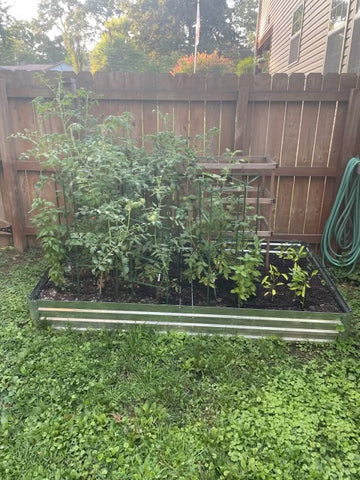
Tomatoes grown with (on the left) and without (on the right) pelletized wool. Image credit: https://krpelletco.com/blogs/news/do-wool-pellets-work-well-with-tomatoes
Wool pellets have also proven beneficial for growing lettuce. “Since 2010, South America has been experiencing a prolonged megadrought, with a 40% reduction in annual rainfall, further intensified by climate change. This situation has led to a severe decline in water reserves, impacting agriculture and food security. To mitigate these effects, the adoption of sustainable agricultural practices, such as the use of sheep wool as an organic fertilizer, has been explored. [One] study evaluated the impact of wool pellets on lettuce growth and soil properties across different substrates. Lettuce seedlings were cultivated in 1 L pots with various soil types (sand, clay, and peat) and different wool pellet doses: a control group (C), a group with 5 g/L (W5), and one with 10 g/L (W10). Plant growth parameters and soil properties were monitored over a period of 120 days. The addition of wool pellets improved soil moisture retention and chemical properties, with moisture levels increasing by 3% to 25% compared to the control, particularly during dry periods. An increase in nitrate (41-54%) and potassium (10-53%) concentrations was observed in both soil and lettuce leaves (1.4 times) compared to the control, particularly in sandy and clay soils. Lettuce growth was significantly enhanced under the W10 treatment, which showed the highest increases in plant weight (2.5 times), leaf number (1.4 times), and height (1.4 times) compared to the control. Wool pellets may thus serve as an effective tool for optimizing soil management in low-fertility environments, promoting more sustained and resilient plant growth under variable water availability.” (Correa et al, 2025).
A 2023 study explored the impact of incorporating wool pellets (0.01 lb per square foot) into growing broccoli, cauliflower, and potatoes. Compared to controls lacking wool pellets, addition of wool pellets significantly increased the production, weight, and diameter of broccoli heads. The yield of potatoes increased by close to 20% in the plots amended with wool pellets. Interestingly, very little difference was observed on adding wool pellets for growing cauliflower.
A recently-published study explored the impact of wool pellets on the soil biological activity when peppers were planted in pots containing wool pellets (4 g per pot), in both low organic carbon and high organic carbon soils. Wool pellet treatments led to increased soil biological activity in both soil types. Plant physiological parameters and N-use efficiency were also improved on admixing wool pellets into the soils. Wool pellets also significantly increased shoot biomass in both soil types.
One ongoing study, funded by a USDA Sustainable Agriculture Research and Education (SARE) grant, is exploring the utility of wool pellets for the cultivation of strawberries and blueberries. This study, being conducted in Iowa and Wisconsin, is taking place between 2025 and 2028.
Our Own Findings (With Help from Collaborators)
We have been having wool pellets made from our skirtings since 2024. Initially we only dug them into the holes where we planted our tomatoes. Although this was a highly unscientific study, as it did not include controls, we did note that our tomatoes showed a much diminished tendency to crack. This was in spite of the fact that we sustained a serious drought during the summer of 2024. The principal cause of cracking in tomatoes is uneven watering; a summer with no rain whatsoever, with watering occurring only weekly, should have promoted cracking. We shared our observations that summer with Master Gardeners at the MD State Fair, and they were intrigued by our observation.
In 2025, we donated wool pellets to Baltimore City Master Gardeners. They tested our wool pellets on several different vegetable crops (and one flower), growing half with wool pellets and half without. They were so excited about the results that they presented them at the Maryland State Fair that year. They found:
- Tomatoes planted with wool pellets at the DIG garden at Cylburn Arboretum bloomed earlier, and their tomatoes ripened earlier.
- Tomatoes, tomatillos, and peppers planted with wool pellets at the Eric Waller Community Vegetable Garden flowered earlier, grew faster, and produced more fruit. Cherry tomato plants planted with wool pellets at this location also produced more tomatoes, and produced fruit at least 2 weeks earlier.
- Wool pellets placed around Snow Leopard melons and eggplants had no evidence of slugs or snails.
- Marigolds grown with wool pellets had darker green, healthier looking foliage.
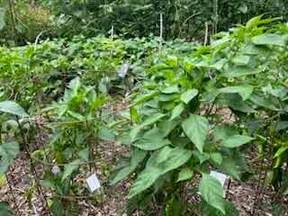
Jimmy Nardello Pepper plants at the Eric Waller Community Garden. The plant on the right was planted with pellets, and the plant on the left was planted without.
To read more about pelletized wool/wool pellets:
“Exploring Low-Phosphorus Wool Pellets as Fertilizer and Soil Conditioner for Vegetables,” University of Vermont Cooperative Extension. Accessed at https://projects.sare.org/sare_project/one20-358/
“Do Wool Pellets Work Well with Tomatoes?” Accessed at https://krpelletco.com/blogs/news/do-wool-pellets-work-well-with-tomatoes
“4 Reasons to Introduce Wool into Your Garden,” American Wool, 2021. Accessed at https://www.americanwool.org/4-reasons-to-introduce-wool-into-your-garden/
“Wool Pellets Nourish Your Garden”. Accessed at https://fermesleystone.com/en/wool-pellets-nourish-your-garden/
Bradshaw, T.; Hagen, K. 2022. Wool pellets are a viable alternative to commercial fertilizer for organic vegetable production. Agronomy 12(5), 1210. Special issue on Agroecology for Organic Vegetable Systems Redesign. DOI:10.3390/agronomy12051210.
Correa, L. M.; Aguileia, G. C.; Ceruti, M. G., 2025. Effect of wool pellets on soil fertility and lettuce growth in three soil types. J. Aridland Agriculture, v. 11, pp. 44-53.
Kovaks, F.; Papdi, E.; Gyalai, I.; Biro, B.; Juhos, K., 2025. Nitrogen supplying capability of wool pellets as an alternative fertilizer depending on soil biological activity. Biologia Futura, v. 76, pp. 419-435.
Roberts, A. L., 2025. Pelletized wool: adding value to ‘waste wool’. Maryland Sheep News (quarterly newsletter of the Maryland Sheep Breeder’s Association), April 2025, pp. 9-11.